

Spain is undergoing a steady yet profound transformation in how people approach food. What used to be a niche preference is now a visible shift in mainstream consumption habits. Whether it’s oat milk replacing dairy in morning coffee, or soy yogurts and veggie burgers becoming household staples, plant-based products are claiming their space in Spanish supermarkets.
According to the latest data from GFI Europe and Smart Protein, the Spanish plant-based retail market reached €491 million in 2024, a +6.6% increase from the previous year and +14.4% growth compared to 2022. More importantly, the +9.8% rise in sales volume confirms that this is a genuine consumer-driven trend, not just the result of rising prices.
At Hola Spanish Market, we’ve seen this transformation firsthand, helping international brands successfully land and grow in this evolving market.
Spanish consumers are becoming more selective and conscious in their food choices. No longer driven solely by price or tradition, they now cite health, environmental concerns, and animal welfare as their main reasons to reduce meat consumption. A 2024 meta-analysis of 57 studies also confirms that plant-based meats emit at least 70% fewer greenhouse gases and use 70% less water and land compared to animal-based counterparts.
This isn’t just a dietary choice, it’s a conscious shift aligned with personal and planetary wellbeing—one that reflects broader plant-based consumer trends seen across Europe.
The strongest performers in Spain’s plant-based market today are:
Additional growth is visible in sweet snacks, baked goods, and seafood alternatives—signs of a maturing category within the plant-based food industry trends.
The following graph shows the evolution of average weekly sales for plant-based meat and milk.
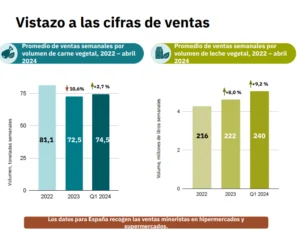
Milk shows a consistent rise, while meat alternatives maintain steady volume. The visual confirms this trend is real and ongoing, fueled by consumer demand, not just seasonal or inflation-driven fluctuations.
Motivations vary, but the top drivers are:
Taste remains the top purchase trigger, followed by freshness, ingredient quality, and avoiding ultra-processed options. According to Smart Protein 2024, 71% of Spaniards trust plant-based labels, considering them transparent, safe, and high-quality.
These plant-based consumer trends indicate a growing expectation for quality, transparency, and ethical alignment, central to today’s plant-based food industry trends.
Despite strong momentum in Spain’s plant-based food trends, several structural and commercial obstacles continue to limit full adoption.
Price remains the most pressing issue, especially for meat alternatives, which are still more than twice as expensive as traditional meat. This price gap reflects deeper problems such as low production scale and lack of infrastructure, two important aspects of current plant-based food industry trends globally.
Another major challenge is tax inequality: plant-based milk is still taxed at 10%, while dairy milk benefits from 0% VAT, despite 90.5% of Spaniards opposing this disparity. This inconsistency in fiscal treatment discourages sustainable consumption and puts plant-based options at a disadvantage.
Limited access in horeca and small retail is also a concern. While supermarkets are increasing their plant-based offerings, cafes, restaurants, and independent stores lag behind, leaving many consumers without options in daily out-of-home consumption.
To accelerate growth in Spain’s plant-based sector, brands must address these barriers with a focus on price accessibility, political advocacy, and better channel penetration.
The future of plant-based food trends in Spain is promising and multifaceted. Consumers are now seeking added functionality, products that support protein intake, gut health, or energy. They’re also gravitating toward convenience: ready meals, grab-and-go formats, and plant-based snacks are gaining traction.
Sustainability continues to matter. Brands that highlight local sourcing, low-impact packaging, and transparent supply chains gain an edge. According to Smart Protein 2024, the most desired products in Spain include burgers (50%), chicken-style products (44%), minced meat (39%), and meatballs (38%).
Investment also reflects optimism: plant-based startups in Spain raised $153M in 2024, nearly quadrupling figures from 2022. Spain is becoming a Southern European leader in plant-based food innovation, as part of broader plant-based food industry trends taking shape across the continent.
While major retailers still lead in volume, regional supermarkets are becoming powerful allies for innovative brands, thanks to faster onboarding and openness to new concepts. Meanwhile, organic stores, pharmacies, and direct-to-consumer platforms are carving out their space in the channel mix.
At Hola Spanish Market, we help brands adapt to this dynamic ecosystem—finding the right retail partners, fine-tuning their positioning, and optimizing their rollout plans to match Spain’s unique plant-based food industry trends.
We offer brands an efficient, market-adapted entry strategy by:
Our team has helped brands go from zero to shelf presence in Spain’s most competitive retailers.
The short answer: yes. Spain isn’t experimenting anymore, it’s evolving fast. Consumers are educated. Retailers are investing. And the data speaks for itself.
If your brand wants to enter or grow in Spain’s plant-based food industry, Hola Spanish Market is your local expert—here to guide you through every step, from market validation to commercial execution. Let’s talk.